Welcome to Tanzania – Arrival in Moshi
Upon arrival at Kilimanjaro International Airport, you will be transferred to your hotel in Moshi. Meet your mountain guide for a detailed briefing and gear check before your trek begins.
The 9 Days Northern Circuit Route offers 9 full days of trekking on Kilimanjaro's longest and most extraordinary route — a complete 360-degree circumnavigation of the majestic Kibo Peak. Covering ap...
The 9 Days Northern Circuit Route offers 9 full days of trekking on Kilimanjaro's longest and most extraordinary route — a complete 360-degree circumnavigation of the majestic Kibo Peak. Covering approximately 90 km, this is the only route that takes you around the entire mountain, traversing its remote northern slopes that very few trekkers ever see. Starting from Londorossi Gate (2,250 m) on the western side — the same start as the Lemosho Route — the Northern Circuit then diverges north instead of south, circling the mountain anticlockwise through pristine, untouched wilderness.
Book This TrekUpon arrival at Kilimanjaro International Airport, you will be transferred to your hotel in Moshi. Meet your mountain guide for a detailed briefing and gear check before your trek begins.
After breakfast, drive from Moshi to Londorossi Gate (2,250 m) — approximately 3–4 hours through the lush foothills of Kilimanjaro. After park registration, begin your trek through the dense montane rainforest, following a winding trail shaded by a towering canopy. The forest here is alive with colobus monkeys, birdsong, and giant ferns. Your destination is Mti Mkubwa Camp (2,820 m), whose name means 'Big Tree' in Swahili — named for the enormous fig trees that dominate the campsite. This gentle introductory hike sets the rhythm for your 9-day circumnavigation.
Leave the forest behind as the trail climbs steadily through a transition zone of heather and moorland vegetation. The path emerges onto the vast Shira Plateau — one of the largest high-altitude plateaus in the world, formed by an ancient volcanic caldera. As you gain altitude, the vegetation gives way to open alpine moorland with giant lobelias and senecios dotting the landscape. Shira Camp 2 (3,850 m) sits on the edge of the plateau with commanding views of the western breach of Kibo Peak. The expansive skies and rolling plains stretch endlessly before you, offering a first glimpse of the circumnavigation ahead.
A shorter day designed to aid acclimatisation while traversing the upper edge of the Shira Plateau. The trail heads north across gentle undulating terrain, passing through sparse alpine desert with scattered volcanic rocks and hardy tussock grass. This is where the Northern Circuit diverges from the Lemosho Route — instead of turning south, you continue north towards the remote Moir Valley. Moir Hut (4,200 m) is a basic camp nestled in a glacial valley at the base of the northern ice fields. The afternoon offers a fantastic acclimatisation opportunity with a hike up the slopes above camp to approximately 4,400 m before descending back to sleep.
Today is the highlight of the Northern Circuit — the remote northern traverse that few Kilimanjaro trekkers ever experience. The trail crosses the northern slopes of Kibo at around 4,000 m, traversing a pristine alpine desert landscape that feels a world away from the busy southern routes. The terrain is a mix of volcanic scree, ancient lava flows, and hardy alpine plants adapted to the harsh environment. To your north, the Great Rift Valley stretches to the horizon, with views across Kenya's Amboseli National Park and Tanzania's wild northern plains. Pofu Camp (4,020 m) — named for the eland antelope — is a wilderness camp perched on the northern side with uninterrupted views of the seemingly endless African plains below.
Continue the northern traverse eastwards, maintaining altitude as you cross more alpine desert terrain. The trail follows the contour of Kibo's northern flank, with the massive bulk of the mountain looming constantly to your south. The landscape is stark and beautiful — volcanic rocks in shades of brown, red, and black scattered across a vast open plain. Buffalo Camp (4,050 m) sits on a ridge offering commanding views north to Kenya and south towards the eastern slopes you'll descend later in the trek. The camp is named for the buffalo that occasionally roam these high slopes, a reminder that Kilimanjaro is also a UNESCO Biosphere Reserve with diverse wildlife.
Today you begin the transition from the northern side to the eastern side of the mountain, descending slightly as you curve around Kibo's north-eastern flank. The terrain changes subtly as you enter the eastern saddle zone, with the distant jagged silhouette of Mawenzi Peak becoming visible ahead. Third Cave Camp (3,870 m) is named for a distinctive cave formation in the area, a remnant of ancient volcanic activity. This slight descent to 3,870 m is a deliberate 'climb high, sleep low' strategy — you'll be sleeping lower than the previous two nights, giving your body a valuable recovery opportunity before the summit push.
A steep ascent day as you climb the eastern slopes of Kibo towards the high camp. The trail ascends consistently through the alpine desert zone, crossing the eastern saddle between Kibo and Mawenzi peaks. As you gain elevation, the vegetation disappears entirely, leaving only volcanic scree and rock. The views backwards over the vast northern plains you've traversed over the past days are breathtaking. School Hut (4,800 m) is the high camp on the eastern side, a basic shelter perched high on Kibo's slopes. After an early dinner, your guide will brief you on the summit attempt, and you'll rest in preparation for an early start.
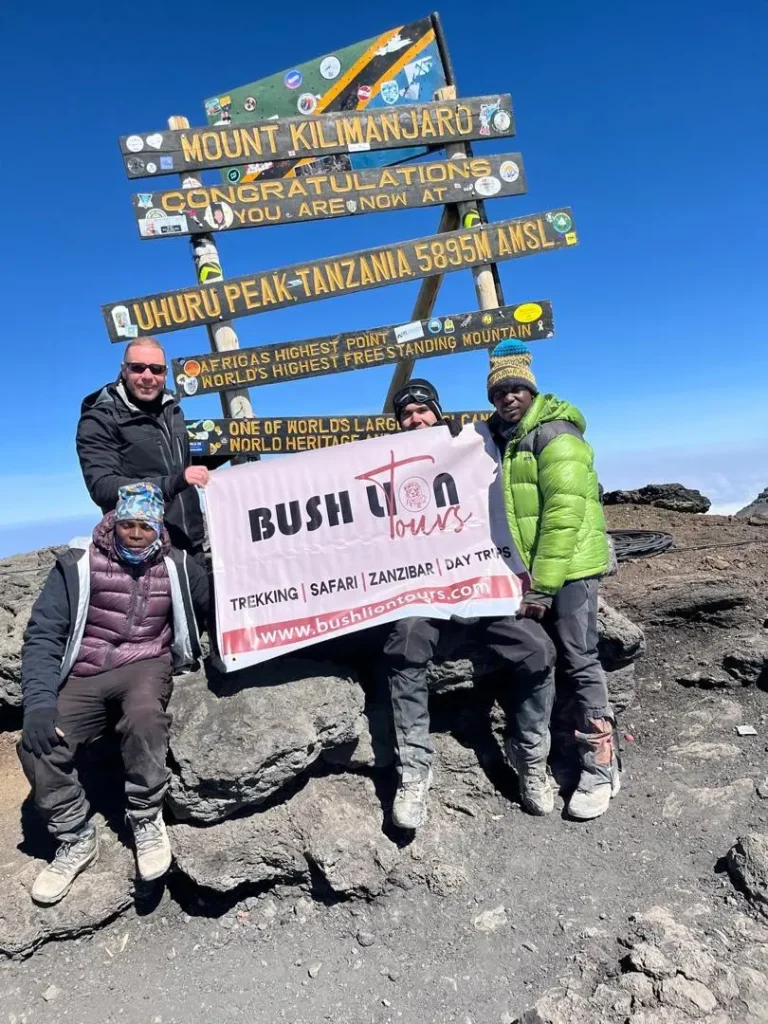
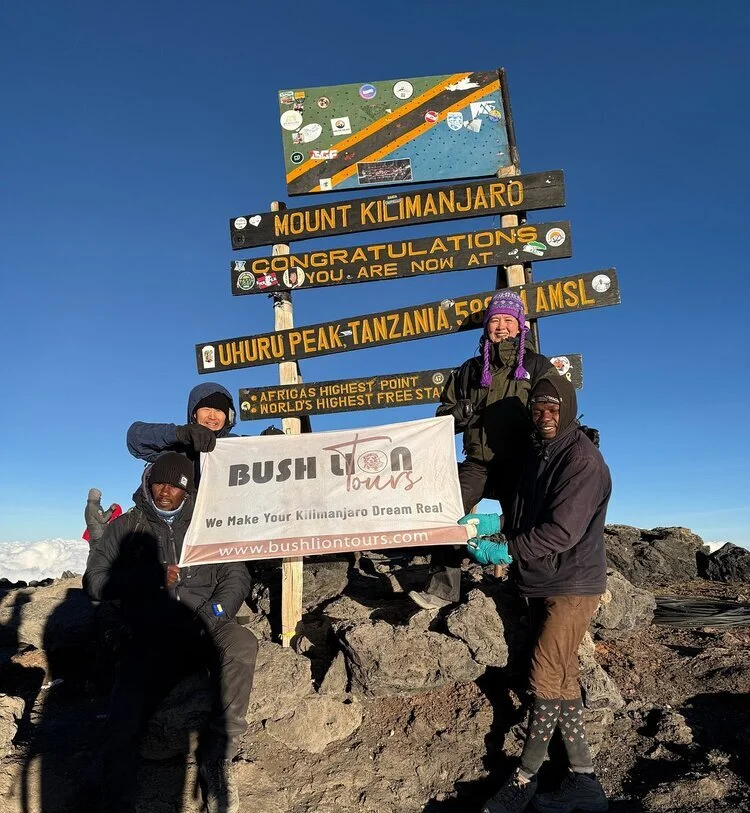
Wake at midnight for hot tea and snacks, then begin the final ascent by headlamp under a canopy of stars. The trail climbs steeply up the eastern scree slope towards the crater rim at Gilman's Point (5,681 m). The gradient is relentless, but the 9-day acclimatisation programme means your body is optimally prepared. Arrive at Gilman's Point in time for a spectacular sunrise over the eastern ice fields — a moment of pure magic at the Roof of Africa. From Gilman's Point, follow the crater rim trail for another hour along the edge of the vast crater to Uhuru Peak (5,895 m) — the highest point in Africa. Celebrate with photos and a quiet moment of triumph before descending via the normal route to Horombo Hut (3,720 m), where a warm meal and comfortable dormitory await.
A triumphant descent through the moorland and lush rainforest of the Marangu route. The trail passes through Horombo's giant heather fields, past Mandara Hut, and winds down through dense forest alive with birdlife and ancient trees. At Marangu Gate (1,870 m), you complete park formalities and receive your Kilimanjaro summit certificate — a proud moment commemorating your 360-degree circumnavigation and summit achievement. Your vehicle meets you for the drive back to Moshi, where a hot shower, celebration dinner, and a comfortable hotel bed await.
Everything you need for a seamless journey — and a clear view of what to arrange yourself.
Secure your spot today with just 20% deposit. Our local experts will craft a personalized itinerary and guide you every step of the way to Uhuru Peak.
A category-by-category checklist tailored to this journey. Items marked essential should not be skipped — rentals are available in Moshi and Arusha.
Practical details every traveller should read before confirming. We'll cover everything again in your pre-departure pack.
Most nationalities need a Tanzanian tourist visa (USD 50, or USD 100 for US passports). You can apply online or get a visa on arrival at JRO. Your passport must be valid for at least 6 months.
Comprehensive travel insurance with medical evacuation cover is mandatory. For Kilimanjaro and high-altitude treks the policy must explicitly cover trekking above 4,000 m and helicopter rescue.
Yellow fever certificate is required if arriving from a yellow fever country. Anti-malaria prophylaxis is recommended. Consult a travel clinic 6–8 weeks before departure.
A 30% deposit confirms your booking; the balance is due 45 days before arrival. We accept bank transfer and card (3% fee). Free rescheduling up to 30 days before departure.
Tipping is customary and an important part of crew income. Guidelines are shared in your pre-trip pack — typically USD 300–350 total per climber for a Kilimanjaro crew.
This trip runs in groups of 1 – 12. Private departures with your own guide and vehicle are available year-round on request — ask us for a custom quote.
You'll sleep above 4,000 m and summit at 5,895 m. No technical climbing skills are needed, but you should be able to walk 5–7 hours per day on consecutive days. We do daily pulse-oximeter checks and carry emergency oxygen.
We follow Kilimanjaro Porters Assistance Project (KPAP) standards: fair wages, three meals a day for porters, proper gear, and a 20 kg load limit. Your booking directly supports ethical mountain employment.
Everything you need to know before your climb. Can't find your answer? Get in touch.
We'll respond within 24 hours with a personalized quote.
Secure your spot with just 20% deposit. Free cancellation up to 24 hours.