
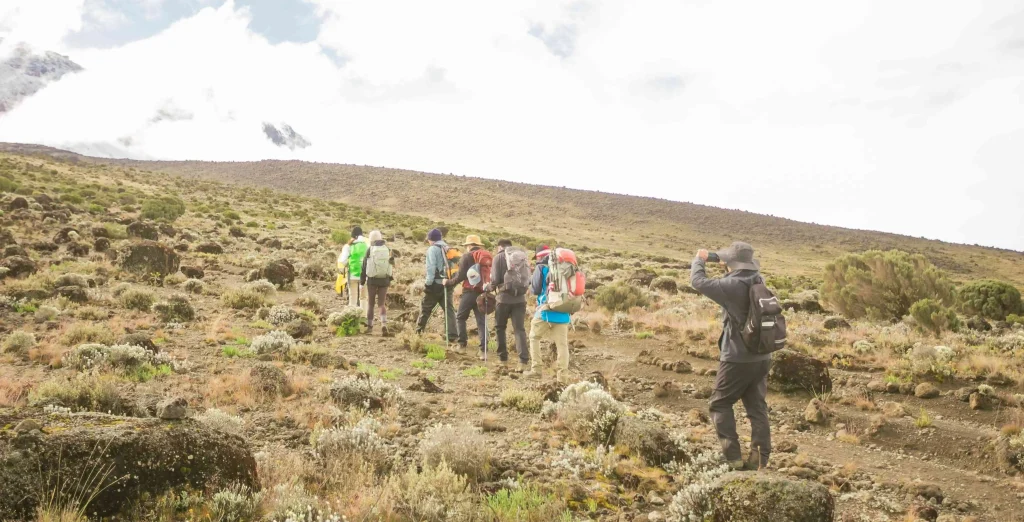
The 9 Days Northern Circuit Route is the longest and most scenic trail to climb Mount Kilimanjaro. Known for its panoramic views and excellent acclimatization profile, this route circles nearly the entire mountain before reaching Uhuru Peak. It offers a quiet and peaceful trekking experience with fewer climbers, making it ideal for those who want a less crowded but rewarding journey to the Roof of Africa.
The extra days on this route allow your body to adapt slowly to the altitude, which greatly increases your chances of reaching the summit successfully. Combining adventure, beauty, and comfort, the Northern Circuit Route is perfect for those who want a complete Kilimanjaro experience.
The Northern Circuit Route is the most recommended route for climbers seeking high success rates and stunning views. It combines sections of the Lemosho Route before turning north around the mountain, giving trekkers breathtaking views of Kenya and the plains below.
Because of its long acclimatization time and low daily elevation gain, it’s considered the safest and most enjoyable route for both beginners and experienced trekkers.
You’ll pass through all the mountain’s climate zones—from lush rainforest to moorlands, alpine desert, and the icy summit. With professional guides, warm camp setups, and delicious meals, you’ll experience Kilimanjaro in comfort and style.
Each day on the Northern Circuit is full of discovery. You’ll walk through quiet trails surrounded by untouched nature, enjoy peaceful camps, and share stories with fellow adventurers under the stars.
Summit night is the ultimate challenge climbing through the cold darkness toward the glowing horizon. As you reach Uhuru Peak at 5,895 meters, the sunrise over Africa is an unforgettable reward for your effort and determination.
This route is perfect for travelers who want the best success rate, excellent acclimatization, and a scenic, less-crowded trail. It suits both experienced hikers and fit beginners ready for adventure.
If you want a route that gives you time to enjoy every landscape and a strong chance to reach the summit, the Northern Circuit is your best choice.
Your Kilimanjaro adventure begins as you arrive at Kilimanjaro International Airport (JRO), where our friendly team will welcome you. You’ll be transferred to your hotel in Moshi town.
Spend the day relaxing, enjoying a refreshing shower, and meeting your mountain guide for a detailed briefing and equipment check. This evening, enjoy a delicious Tanzanian dinner while discussing the next day’s journey.
Accommodation: Maridadi Hotel / Parkview Inn
Meals: Dinner
After breakfast, drive to Londorossi Gate on Kilimanjaro’s western side (approx. 2 hours). You’ll complete registration and meet your mountain crew — guides, cooks, and porters.
Begin trekking through dense tropical rainforest where black and white colobus monkeys leap among the trees and colorful birds sing overhead. The trail is gentle but can be muddy, so trekking poles and gaiters help. You’ll reach Mti Mkubwa Camp (Big Tree Camp) by late afternoon.
Distance: 6 km | Time: 3–4 hrs
Vegetation: Rainforest
Accommodation: Mti Mkubwa Camp (Full-Service Camping)
Meals: Breakfast, Lunch, Dinner
Leave the rainforest behind as you climb into the heather and moorland zone. The trail becomes steeper, but the scenery opens up with wide views of Shira Ridge and Mount Meru in the distance.
After several hours of hiking, you’ll emerge onto the Shira Plateau, a high-altitude volcanic plain. Your camp for the night, Shira 1 Camp, sits in the middle of this vast landscape, offering beautiful sunset views.
Distance: 8 km | Time: 5–6 hrs
Vegetation: Moorland
Accommodation: Shira 1 Camp
Meals: Breakfast, Lunch, Dinner
Today is a shorter and easier trek that helps your body adjust to higher altitude. Walk slowly across the Shira Plateau — one of the most scenic areas on Kilimanjaro.
You’ll pass small lava formations and unique highland plants. Arrive at Shira 2 Camp in the early afternoon, giving you time to relax, take photos, and enjoy the mountain’s peaceful silence. At night, the stars shine brightly over the plateau.
Distance: 7 km | Time: 4–5 hrs
Vegetation: Moorland
Accommodation: Shira 2 Camp
Meals: Breakfast, Lunch, Dinner
This is an important acclimatization day. The trail climbs gradually to Lava Tower, a large volcanic rock formation at 4,630 meters. Here, you’ll rest for lunch and enjoy views of the Western Breach.
Afterward, descend to Moir Hut Camp, set in a peaceful valley below Lent Hills. This “climb high, sleep low” strategy helps your body adapt to the altitude and prepares you for the summit later.
Distance: 14 km | Time: 6–8 hrs
Vegetation: Alpine desert
Accommodation: Moir Hut
Meals: Breakfast, Lunch, Dinner
Begin the day with a short but steep climb out of Moir Valley. From here, you’ll follow the Northern Circuit trail around the mountain’s north side, away from the crowds.
The landscape is quiet and untouched, offering panoramic views of the Kenyan plains and Kilimanjaro’s rugged slopes. You’ll reach Buffalo Camp in the late afternoon, where you can relax and watch a colorful sunset.
Distance: 12 km | Time: 6–7 hrs
Vegetation: Alpine desert
Accommodation: Buffalo Camp
Meals: Breakfast, Lunch, Dinner
Today’s trek is gentle and enjoyable. Walk through open terrain and small valleys filled with alpine plants. You’ll notice how quiet the northern side of Kilimanjaro is — it’s a perfect place for peaceful reflection.
Arrive at Third Cave Camp in the afternoon and rest early as the air becomes thinner with altitude.
Distance: 8 km | Time: 5–6 hrs
Vegetation: Alpine desert
Accommodation: Third Cave Camp
Meals: Breakfast, Lunch, Dinner
Today you’ll climb steadily toward School Hut, your final base before the summit attempt. The air gets colder and thinner, so walk slowly and drink plenty of water.
Upon arrival, rest and prepare your gear for summit night. Have an early dinner and sleep early — tomorrow you’ll climb to the top of Africa!
Distance: 5 km | Time: 4–5 hrs
Vegetation: Alpine desert
Accommodation: School Hut
Meals: Breakfast, Lunch, Dinner
This is the most challenging and emotional day of the trek. You’ll wake up around midnight and begin the final climb under a sky full of stars.
The trail is steep and cold, but your guide will lead you slowly to Gilman’s Point, then to Uhuru Peak — the highest point in Africa.
Reaching the summit as the sun rises over the plains below is a breathtaking and unforgettable experience. After celebrating and taking photos, descend back to Barafu Camp for a short rest, then continue down to Mweka Camp for the night.
Distance: 16 km | Time: 12–14 hrs
Vegetation: Arctic zone → Moorland
Accommodation: Mweka Camp
Meals: Breakfast, Lunch, Dinner
Enjoy your final breakfast on the mountain before descending through the lush rainforest to Mweka Gate. Here, you’ll receive your summit certificate — a proud memory of your adventure.
Our driver will meet you and transfer you back to your hotel in Moshi. The rest of the day is free to relax, celebrate, and reflect on your incredible journey.
Distance: 10 km | Time: 3–4 hrs
Vegetation: Rainforest
Accommodation: Maridadi Hotel / Parkview Inn
Meals: Breakfast, Lunch
Prices (quoted in USD/per person)
| 1 Pax | 2-4 Pax | 5-6 Pax | 7-9 Pax | 10+ Pax |
| $2,850 USD | $2,508 USD | $2,320 USD | $2,250 USD | $2,150 USD |
For a more accurate estimate, it’s best to contact us directly and discuss your specific requirements and budget. We can provide you with a detailed quote based on your itinerary, group size, and preferred level of comfort
The Northern Circuit Route is considered moderate to challenging. It’s one of the longest routes on Kilimanjaro, giving climbers plenty of time to acclimatize. The trek is physically demanding, especially during summit night, but with proper preparation, it offers one of the highest success rates on the mountain.
The best time to climb is January to mid-March and June to October. These are the dry seasons, offering clear skies, great visibility, and stable weather. However, December can also be beautiful with fewer crowds.
Altitude sickness can affect anyone, regardless of fitness level. The Northern Circuit Route is ideal because it allows for gradual acclimatization over nine days. Drinking plenty of water, walking slowly (“pole pole”), and eating well are key to preventing altitude sickness.
Yes, some vaccinations are recommended. Travelers should be up-to-date on yellow fever, typhoid, hepatitis A and B, and tetanus. It’s best to consult your doctor before traveling to Tanzania.
The Northern Circuit package includes park fees, camping equipment, professional guides and porters, meals, drinking water, rescue fees, and transport from and to Moshi. Not included are personal climbing gear, tips, travel insurance, and international flights.
The following is a recommended packing list for Kilimanjaro:
DOCUMENTS
GEAR & CLOTHING
(please make sure that you have non-cotton clothing for trekking):
If you don’t want to purchase your own kit or need to travel light, you can hire most of the equipment from our guides in-country. Get in touch for the list and rental prices. Please note that all plastic bags, regardless of their thickness, are prohibited from being brought into Tanzania. This excludes packaging for medical supplies.
Tipping is a traditional part of the Kilimanjaro culture. Recommended tips are $20–25 per day for guides, $15–20 per day for cooks, and $7–10 per day for porters. Tips are collected at the end of the trek and distributed fairly among the crew.
Yes, If you are travelling solo and would like your own room and tent for the duration of the trip, you can pay for a single supplement. The single supplement is an optional extra with a cost of $50 per traveller. This is payable in-country. Should you not wish to apply the single supplement, we will pair you with another group member to share accommodation during the trek (twin hotel room and shared tent).
You have chefs with you on the hike who can cater to all dietary requirements. During the trek, you will be provided with three nutritious and filling meals each day to keep energy levels high. Please provide full details of any dietary requirements and allergies on your Trip Form. You will receive a link to fill this out shortly after booking. Note that lunch and Dinner (at the hotel) on your first and final day is not included.
Portable toilets are available as an optional extra to enhance your comfort during the climb. For individual travelers, this service costs $70 per person, payable at our offices in-country. However, for groups, we provide portable toilets free of charge as part of our commitment to making your group adventure as enjoyable and convenient as possible.
Most groups have 3 people, with a maximum of 14.
Accommodation is in high-quality mountain tents, set up and taken down by porters each day. Sleeping mats are provided, and you’ll have a mess tent for dining and socializing in the evenings.
Every day on the trek we will provide you with filtered water to fill up your bottles. The water is filtered and boiled by a Katadyn filtration system. We recommend you also bring water purification tablets or a filter bottle.
The route takes 9 days, which includes 8 days on the mountain and 1 day for arrival or rest in Moshi. This extra time allows for better acclimatization and an increased chance of reaching the summit.
The start and end point of this tour is Kilimanjaro International Airport. There are three pick-up times (10:00 AM, 5:00 PM or 11:59 PM). On the last date, you can fly at any time. Your guides will arrange transfers that work best for the group. Guests typically fly with BA, Air France, or Qatar. However, we’d recommend comparing a few airlines.
Porters are included as part of your trekking team. The porters will carry all the supplies, camping gear, water and also your main luggage. There is a 15kg limit for personal luggage that the porters will carry. This should be packed into a flexible duffel bag, 90l is a good size. This personal luggage includes your sleeping bag (provided) which must also fit into the duffel bag. Extra luggage and suitcases can be left in the locked storage room of the lodge.
The Northern Circuit has the highest summit success rate of all Kilimanjaro routes, averaging over 95%. The extended itinerary allows your body to adjust gradually to the altitude.
Kilimanjaro is very close to the equator, so the temperatures are very similar year-round. They can range from around 20°C(68°F) at the base to -10°C (14°F) on the summit. The dry season is June-September, and during these times, there is typically just a dusting of snow on the summit. These are also the busiest months. The wet season is Nov-May, where snow depth on the summit can regularly be 20-30cm.
Yes, of course! Safari in Tanzania is an amazing experience – simply message the Bush Lion team before/ after booking and we’ll help you arrange a 2-7 day safari.
Climbers must be at least 10 years old to climb Mount Kilimanjaro. Any person under the age of 15 years must be accompanied by a responsible adult.
Tell us your travel dates, number of people, and what you’re interested in, and we’ll send you a free quote with the best suggestions.
100% local tour company based in Tanzania. We offer Kilimanjaro climbs, wildlife safaris, Zanzibar trips, and cultural tours. Travel with experts. Support local.


© 2025 Bush Lion Tours. All Rights Reserved. | Website by Bush Lion Team 🇹🇿